Showing posts with label sushi. Show all posts

Monday, March 10, 2014

Cooking Journal #29


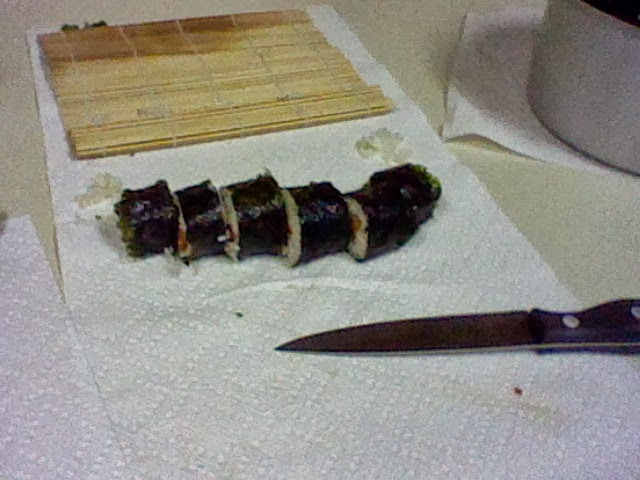
Cooking #29 Breakfast Sushi


Well, well. This isn't how it's done! There's an art in making sushi omelette and obviously, this is not it. In fact, I simply fried the eggs while rolling the sushi. Notice, there's no wasabi involved. I use sriracha!

Next time I do this, I'll do scattered sushi. The nori can be cut up into little stripes and use as sprinkled garnish.

Thursday, March 6, 2014

Book Review #26


Sushi with Style
Ellen Brown

I think I have too many sushi book when I start buying them even though they're written by non-Japanese. Then again, the as long as the information presented is good, that's good enough for me. I think there must be something alluring for what is essentially a piece of raw meat stacked on top of rice.

The simpleton in me rebelled at the list of ingredients. Rice, vinegar, soy sauce, hot sauce, and maybe pickled ginger, is what I use for my sushi. Actually, soy sauce and hot sauce are optional, since I just use Sriracha. Of course, mine is not "authentic" Japanese sushi. No sushi that does not use authentic Japanese ingredients can be called authentic. Still, that just means that sushi recipes are pretty easy to do. It's hard to make a mistake when there's only a few ingredients, most of them uncooked.

I got the book in a kit, with bamboo mat and chopstick. Since I mostly make scattered sushi (in a bowl), as opposed to rolled sushi, the bamboo mat is mostly unused. Still, the recipe here are well done. Even if the illustrations are sometimes lacking, there's enough recipes there to try, and experiment. Some of the recipes employ easily found ingredients, and that's a plus.

If you ever wanted to know about sushi, but don't know where to start. This book and a sushi kit should get you going just fine.

Monday, December 16, 2013

Cooking Journal #17


Rolled Sushi


If you are interested in sushi at all, you probably have one of those sushi making kit. The truth is, you don't really need it. But if you have it, I'll show you how to do it real quick.

You need nori sheet. That's seaweed. I bought the cheap kind, which is not what you want. You want the nice flat kind with smooth surface on one side. Mine, as you can see, is bumpy all over.


Lay down the nori sheet on bamboo mat, shiny side down. Put rice and meat on top. I use spicy hot dog cut length-wise. If you want, you can add some veggies like cut carrots or celery sticks. You can use condiment. I like to use sriracha on mine. No need to use wasabi on it unless you crave authenticity.


Roll the sushi using bamboo mat. The most important point is to press evenly along the spine. Firm enough to press the rice, but not so hard as to compress them solid. By the way, use two hands while doing it. My other hand was holding the camera.

Also, I should tell you that the bamboo mat is optional. One time, I was doing it, and I realized that I forgot to put the mat under the sheet. So what I did was pick up the paper towel and roll the sheet with it. Works just fine, although not as easy as with the mat.

Wet the end of the sheet so that it sticks together when rolled over.


And that's what you should have. One rolled sushi.


Cut into six equal length. Notice that I'm using a proper kitchen knife for this. Buck knife is not good enough for this. To be honest, even this sharp kitchen knife is less than ideal. The sharper the knife, the better! Use the sharpest knife you have, and use it only for cutting sushi rolls!


That's the result, and I can tell you that spicy hot-dog makes a good substitute for avocado used in California Rolls. Serve on plate with pickled ginger. I have yet to find a good substitute for pickled ginger. So that and the nori seaweed are the two must have ingredient for a good rolled sushi.

Monday, December 9, 2013

Cooking Journal #16


Cooking Sushi


Probably not the best title. You're probably wondering: It's Sushi! What is there to cook? Actually, sushi refers to the vinegared rice or sumeshi. There are all kinds. Rolled sushi, finger sushi, scattered sushi, and pressed sushi.

The one I like to make is actually scattered sushi, which is vinegared rice in a bowl with ingredient scattered on top.

Finger sushi is the one you find in a good sushi restaurant. It takes skill to press sushi and meat just right.

Rolled sushi is the one you find in a supermarket. It's relatively easy to make, and makes a nice presentation. Better than the scattered sushi type.

I've never seen pressed sushi. I imagine it's a cheap industrialized kind.


The traditional way to cook sushi rice is with wooden bowl. Once the rice is cooked, dump it into a wooden bowl. Sprinkle vinegar+sugar mixture, while fanning vigorously. The rice will then have the proper texture and consistency while having illustrious sheen on the surface.

Does it matter? Having done it that way, I'd say yes. It makes for a better sushi rice. Of course, my motto is "cheap, fast, and easy" and so I don't usually bother doing any of that.

I also just cook my regular long-grain rice, instead of special sushi rice.

As soon as the rice is done, I fluff the rice using bamboo spatula while sprinkling vinegar a little bit. As you can see, I use it straight from the bottle. I don't bother mixing a special solution for it. And no, I don't use wooden bowl to do it.

The result is less than ideal, but close enough to the real thing, that I don't mind at all. Of course, you may have a different opinion about it.

Then I simply put the rice into a bowl and top it off with some meat I have on hand. That usually means hot-dog.

What? You expect maybe some special sashimi for it? ;)


Thursday, October 31, 2013

Book Review #8


Easy Sushi
Emi Kazuko

Easy Sushi is one of the numerous sushi book I have. Even though I rarely eat raw meat, being too cheap to spring for sushi grade, I nevertheless enjoyed the pictures and presentation of the materials. There is nothing fancy about preparing for sushi. This being vinegared rice, some nori seaweed sheets, and some meat (usually raw) on top. That's about it.

Nothing much in regard to secret ingredient as well. The recipe for sushi is well-known. The book does have simplistic elegant presentation which I like, and there's some materials near the end of the book that updates the recipes somewhat. As far as sushi book, this is average. But as coffee table book, I really like this one. So, think less of a cooking book, more of an art book. If you think your food should be artistic, then give this book a try. You may like what you see.